Table of Contents
If you drive a Ford F-150, Toyota Camry, or Honda CR-V, your repair shop has probably seen dozens of vehicles just like yours this week. America’s best-selling cars don’t fail because they’re poorly built. They fail because millions of them rack up miles under similar conditions, and that kind of volume makes patterns easy to track. This guide covers the specific failure points, rough cost ranges, and repair decisions owners of these ten vehicles are most likely to face.
The vehicles covered here – the Ford F-Series, Chevrolet Silverado, Ram Pickup, Toyota RAV4, Toyota Camry, Honda CR-V, Chevrolet Equinox, Tesla Model Y, Toyota Tacoma, and Honda Civic, account for a disproportionate share of vehicles on U.S. roads. Their market presence means repair data on them runs deep. Shops handle so many of these vehicles that failure patterns stop being anecdotal pretty quickly.
This isn’t a complete breakdown of every possible repair scenario. Most of what follows is about which components actually cost people money, what to expect to pay, and when it’s worth making a few calls before you approve whatever the shop quotes you. Full-size truck repair bills tend to run $800 to $1,200 more per year than compact crossovers, and that spread widens noticeably past 100,000 miles.
What These Repairs Have in Common
Pull repair records on any of these vehicles and the same categories keep coming up: brakes, batteries, electrical sensors, suspension, drivetrain. A Ram 1500 and a Honda Civic share almost nothing mechanically, but the failure categories are nearly identical.
Nobody needs to be told brake pads wear out. What’s worth knowing is that oxygen sensors trigger check engine lights on Toyotas and Chevrolets at roughly the same mileage, that battery failure follows a three-to-five-year schedule on almost every brand, and that the sheer number of these vehicles on the road means the failure patterns aren’t estimates.They appear in dealer records , the NHTSA complaint database, and years of third-party repair tracking.
The financial gap between OEM dealer pricing and quality recycled components gets significant fast once you’re into drivetrain or major electrical work. Take alternators. Dealer price installed: $350 to $500. A tested recycled unit from a low-mileage donor: $80 to $150. On a 130,000-mile vehicle where you’re weighing whether to keep it, that kind of spread actually moves the needle.
America's Best-Selling Trucks: F-150, Silverado, and Ram
The three best-selling vehicles in the U.S. are all full-size pickups, and each has well-documented repair patterns that owners and shops see with regularity.
Ford F-150
The 5.4-liter three-valve engine is where a lot of F-150 repair conversations start. Spark plugs on that engine are notorious for seizing into the cylinder head, and when a plug breaks during removal, a straightforward maintenance job can turn into a $400 to $800 repair. Shops that work on these trucks a lot have a standard process for it, but owners who don’t know it’s coming are often caught off guard.
Cam phaser noise and timing chain tensioner wear showed up on many 5.4L and early 3.5L EcoBoost engines. If you hear a rattle at startup that clears after a minute or two, that’s often the phasers. Catching it early usually keeps the repair in the $600 to $1,200 range. Let it go and the number climbs considerably.
The blend door actuator is less serious but genuinely irritating. When it goes, you get a clicking from somewhere inside the dash, persistent, repetitive, hard to tune out. It doesn’t affect how the truck drives, but most owners can’t leave it alone for long. Rear wheel bearing wear is a different matter. That one shows up as a low hum that shifts pitch with your speed, and it gets louder the longer you let it go.
Owners comparing replacement pricing can connect with suppliers through used Ford auto parts and used engines for sale through the Used Auto Parts Pro network.
Chevrolet Silverado
The AFM (Active Fuel Management) system on certain 5.3-liter Silverado engines has a documented lifter failure problem. The system shuts down cylinders under light load to save fuel, but the lifters on some production runs didn’t hold up long-term. The result is a ticking noise that can progress into a genuine engine repair if ignored. GM redesigned the lifters in later model years, but plenty of older trucks are still in service.
Fuel pump module failures are another consistent Silverado complaint. They don’t always announce themselves dramatically, but a failing pump module can cause hard starts, stalling, or erratic fuel gauge readings. Transmission shudder in some 8-speed automatic configurations has also been widely reported, particularly under light throttle at highway speeds.
Owners weighing a larger repair versus replacement can compare pricing through used Chevrolet auto parts, used transmissions, and used transfer cases through the Used Auto Parts Pro network.
Ram Pickup
The Totally Integrated Power Module, known as the TIPM, became a real headache for Ram owners with trucks built in the late 2000s and early 2010s. The TIPM controls the fuel pump, horn, wipers, windows, and several other systems. When it starts failing, the symptoms can look like several unrelated problems happening at once. New replacement units ran $1,000 to $1,500 at dealers. A properly tested recycled unit could cut that cost in half or more.
Rear axle seal leaks, worn front suspension ball joints, and transfer case wear on four-wheel-drive models are also consistent patterns on higher-mileage Rams. The problem isn’t that any one of these is catastrophic on its own. It’s that they tend to stack up around the same mileage, usually 80,000 to 120,000 miles, so what you thought was one repair turns into three.
Diesel-equipped Rams with the Cummins 6.7L engine add DEF system complexity to the mix. NOx sensor failures and EGR issues are common enough that diesel Ram owners generally plan for them. Parts costs on the emissions system range widely: $200 for a sensor to $1,500 or more for DEF injector work.
Truck owners sourcing drivetrain parts can compare options for used transfer cases, used diesel truck engines, and used transmissions through Used Auto Parts Pro.
Since 2021, over 30 states have enacted or expanded legislation targeting catalytic converter theft through documentation requirements. The requirements vary in specifics but share a common structure. Anyone purchasing a used catalytic converter, whether from a salvage yard, a recycler, or an individual buyer, must collect government-issued photo ID from the seller, record the VIN of the donor vehicle, obtain the license plate number of that vehicle, get a signed ownership declaration, and retain all of that documentation for a minimum period. Two to five years is the standard retention range depending on the state.
California, Texas, Colorado, Illinois, Minnesota, Oregon, and Washington are the states where used catalytic converter laws carry the most demanding compliance obligations. California is its own category and worth treating separately from the rest of the list. Every other state on it deals with either emissions compliance or theft documentation requirements. California requires both, and the CARB standard that applies to replacement converters is stricter than the federal EPA standard that applies everywhere else. A converter sold in California has to clear both hurdles. Most used converters from salvage vehicles do not clear the CARB side, which makes California effectively off-limits for the used converter market on inspection-subject vehicles.
Texas updated its used catalytic converter laws in 2023 with additional accountability requirements for recyclers and secondary metal dealers. Sellers must now provide a signed statement confirming ownership or authorization to sell, and the seller’s identification gets recorded and held for a minimum of 25 months. Colorado added a financial documentation layer on top of similar record-keeping requirements: transactions above certain dollar thresholds have to go through check or electronic payment rather than cash, building a verifiable paper trail into higher-value converter sales.
Oregon and Washington deserve separate attention. Both have emission compliance laws tied to state vehicle inspection requirements, and both added documentation requirements for converter purchases and sales on top of that. In those states, a used converter does not just need clean paperwork on its source history. It also has to meet the emissions performance standards for the vehicle it is going into before installation is legal. Drivers comparing converter pricing alongside other repair components frequently search used Toyota auto parts and used Honda auto parts to benchmark the full scope of repair costs before approving dealer estimates.
Toyota RAV4 and Camry: Strong Reputation, Real Maintenance Costs
Toyota’s reliability reputation is earned. Long-term ownership studies consistently rank the RAV4 and Camry near the top for total cost of ownership, and the data backs that up. But reliable doesn’t mean maintenance-free, and past around 90,000 miles these vehicles develop their own patterns.
The RAV4 has become one of the most frequently targeted vehicles for catalytic converter theft. The converter sits high off the frame and is easy to access with a reciprocating saw in under a minute. OEM replacement through a Toyota dealer can run $2,000 to $3,500 depending on the model year and your state’s emissions requirements. California-spec vehicles require CARB-compliant replacements, which adds to the cost.
Some four-cylinder RAV4 and Camry engines built in the mid-2010s drew owner complaints about above-average oil consumption between changes. It doesn’t always cause a failure on its own, but owners who don’t check the oil level between service visits can end up with low-oil damage that costs far more than the quart they would have added. Older Camry models also see water pump and AC compressor failures at higher mileage, typically in the 100,000 to 140,000-mile range.
Owners comparing replacement costs can connect with suppliers through used Toyota auto parts and used engines for sale via Used Auto Parts Pro.
Honda CR-V and Civic: Efficient Engines With Known Trade-offs
Honda built the 1.5-liter turbocharged engine in the 2017 to 2021 CR-V to deliver strong fuel economy in a family-sized crossover. Under normal driving conditions it does that well. The problem showed up in cold climates, where short trips and infrequent highway use allowed raw fuel to work past the piston rings and dilute the engine oil. Honda issued software updates and service measures in response, and it’s less prevalent in newer builds.
If you own an early 1.5T CR-V and live somewhere with real winters, checking the oil level and smelling the dipstick for gasoline between regular service visits is worth the 30 seconds. Oil dilution doesn’t always trigger a warning light.
AC compressor failures come up repeatedly across multiple CR-V and Civic generations. On the Civic specifically, rear wheel bearings often show wear after 100,000 to 120,000 miles. Neither repair is expensive on its own, but they tend to arrive at the same time, which can make a single service visit cost more than the owner anticipated.
Drivers comparing replacement component pricing can connect with used Honda auto parts suppliers and review nationwide used car engine listings through Used Auto Parts Pro.
Toyota Tacoma and Chevrolet Equinox
Tacoma owners have a well-documented reason to inspect the frame on trucks built between 2005 and 2010. Frame rust on those years became serious enough in rust-belt states that Toyota initiated a buyback and replacement program. Many affected trucks were retired through that process. Newer Tacoma generations use improved corrosion protection, though the truck’s work-oriented use still means suspension wear, leaf spring fatigue, and U-joint replacement appear on high-mileage examples.
The 2.4-liter four-cylinder Equinox has generated a consistent repair conversation around timing chain wear and oil consumption. GM issued a service bulletin addressing the concern, but owners who didn’t get the repair on schedule sometimes ended up with accelerated engine wear. Some engines in this configuration needed replacement well before 150,000 miles, which is earlier than most Equinox owners expect.
Owners facing larger engine or drivetrain repairs can compare pricing through used Chevrolet auto parts, used engines for sale, and used transmissions before committing to a dealer quote.
The Parts That Wear Out on Practically Everything
Oxygen Sensors
Oxygen sensors are the single most common cause of check engine lights, full stop. Most vehicles run two or more sensors monitoring emissions and fuel mixture, and they degrade over time based on driving conditions, fuel quality, and engine health. Replacements typically run $50 to $200 for the part alone. Because they’re inexpensive consumables, new sensors are the better call over recycled ones.
Brake Pads and Rotors
Brake pads and rotors are the highest-volume repair category in the industry. Heavier vehicles, particularly full-size trucks and three-row SUVs, burn through them faster. Towing loads accelerate wear significantly. Pad replacement alone on a full-size pickup can run $200 to $400 per axle at a shop, with rotor replacement adding $100 to $200 per axle on top of that. The Car Care Council recommends inspection at every tire rotation. Most owners wait until they hear something.
Alternators and Starters
Alternators and starters typically last seven to ten years depending on climate and usage. Both are strong candidates for quality recycled replacements. A new OEM alternator can run $350 to $600 installed. A properly tested unit from a low-mileage donor vehicle often costs $80 to $200 through a supplier network, and in most cases performs the same way. Used auto parts suppliers that test components before listing them reduce the risk substantially.
Batteries
Battery life averages three to five years, and heat is the bigger enemy here, not cold. Extreme summer temperatures in regions like Arizona or Texas can shorten battery life to under three years. Pricing varies significantly across brands and retailers, so shopping around before buying is worth a few minutes.
When a Recycled Part Makes Financial Sense
Not every repair is a good candidate. Consumable items like brake pads, spark plugs, oxygen sensors, filters, and belts should generally be purchased new. These are low-cost, high-cycle components where fresh manufacture matters.
A lot of expensive repairs, though, fail for reasons unrelated to gradual wear. Alternators fail because of a bad voltage regulator, not because the housing is worn out. AC compressors seize because of a failed clutch bearing. Transfer cases leak because a seal degrades. In those cases, a properly tested recycled component from a vehicle with significantly fewer miles can perform as reliably as a new replacement at a fraction of the cost.
Engines and transmissions are where the math gets most dramatic. A remanufactured crate engine for an F-150 or Silverado can run $4,000 to $7,000 installed at a dealer. A tested low-mileage used engine from a wrecked or flood-damaged donor vehicle with 40,000 to 60,000 miles on it might run $1,500 to $2,800 through a supplier that documents mileage and backs it with a limited warranty.
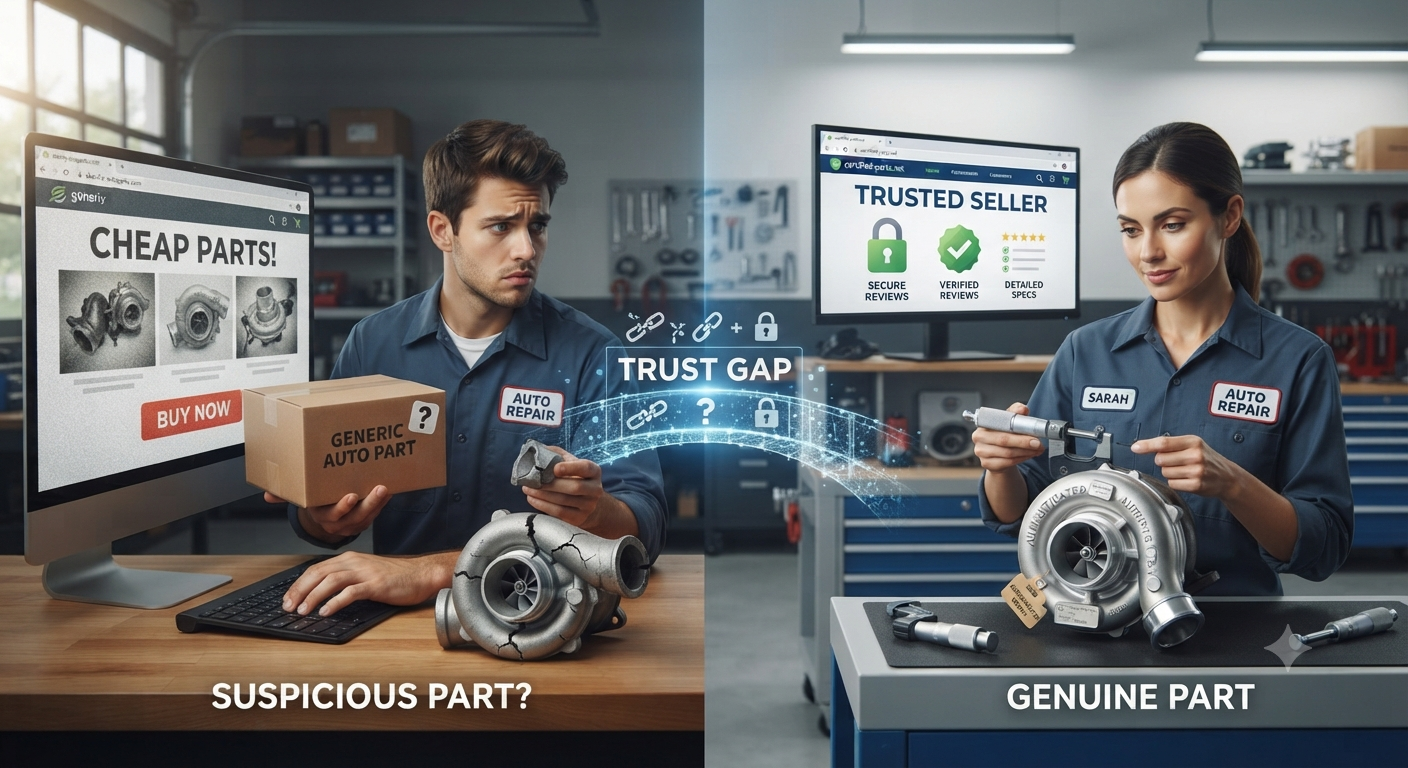
The question to ask isn’t ‘is it new?’ It’s ‘can I verify where it came from and what condition it’s in?’ Buyers who ask for mileage documentation, check for obvious damage, and purchase from suppliers with return policies tend to do well. Buyers who go with the cheapest listing and no information generally don’t.
For larger repairs involving engines or transmissions, comparing your shop quote against used engines for sale, used transmissions, and the broader used auto parts inventory available through Used Auto Parts Pro’s supplier network can change what a repair actually costs by thousands of dollars.
Frequently Asked Questions
Brakes, oxygen sensors, and batteries, in roughly that order, cover most repair visits across all vehicle types. Get past 80,000 miles and alternators, starters, and suspension parts start showing up on the same invoice. Which specific part fails varies. Which category it falls into almost never does.
Anything that fails because of an isolated defect rather than gradual wear. Alternators, starters, AC compressors, transfer cases, engines, transmissions – these are the candidates. A low-mileage tested unit from a donor vehicle typically runs 40 to 60 percent less than new and performs the same way.Wear items—pads, sensors, plugs, and belts—should usually be bought new.
Pay attention to how the vehicle feels, sounds, and responds when something feels wrong. Transmission slipping, brake pedal going soft, temperature gauge climbing, car losing power out of nowhere – none of that waits. A check engine light by itself is less clear-cut. Could be a $50 oxygen sensor, could be something worse. You won’t know until someone reads the codes, so don’t keep resetting it and hoping.
Almost always yes, if the vehicle is otherwise sound. A $2,500 engine repair is still cheaper than the first three monthly payments on a replacement vehicle. The math changes when multiple major systems are failing at the same time or when frame, body, or transmission condition makes further investment impractical.
Buyers compare listings through national supplier networks offering used car engines for sale and used transmissions with mileage verification, VIN compatibility tools, and available warranty coverage before purchase.
On Toyotas, check oil consumption between services and keep the RAV4’s catalytic converter vulnerability in mind, especially if you park on the street. On Hondas, the 1.5T CR-V engine needs regular oil inspection in cold climates. Rear wheel bearings on high-mileage Civics are worth including in your next inspection if the vehicle is approaching 110,000 miles.
Used Auto Parts Pro connects vehicle owners directly with vetted domestic salvage yards and recyclers across the country. We don’t hold stock or ship parts from our own warehouse. When you connect through our platform, you’re dealing directly with the supplier who has the part.
For high-cost repairs, comparing your shop quote against available recycled components can change what the repair actually costs. The savings on a single engine or transmission job often covers months of car payments.
Connect With Parts Suppliers Through Used Auto Parts Pro →
Published by Used Auto Parts Pro, a marketplace connecting buyers with quality recycled and salvaged components for domestic and import vehicles.