Table of Contents
Table of Contents
A buyer identifies a need. The buyer searches across available channels. The buyer calls to verify. The buyer places an order and waits. Something goes wrong. The buyer calls again.This is the sequence that technology has been promising to eliminate for years. And for the first time, the infrastructure to actually eliminate it is being built, piece by piece, in real deployments across the industry. The shift is not coming. It is already underway. What is not yet clear is who benefits from it and who gets left behind.
The Scale of What Is Being Built
U.S. e-commerce sales of automotive aftermarket parts were forecast to reach approximately $44.6 billion in 2025, including third-party marketplaces, according to the Auto Care Association and MEMA Aftermarket Suppliers’ 2025 Joint E-Commerce Trends and Outlook Forecast. That growth is not confined to consumer purchases. Recyclers and vendors across the industry are visibly investing in the real-time inventory, AI-powered search, and dynamic pricing infrastructure described below. This is not a speculative projection about a market that might develop. It describes investment already flowing into infrastructure, platforms, and capability that is actively reshaping how parts are sourced, priced, and delivered. The question for the used auto parts ecosystem is not whether technology will transform procurement. It already is. The question is whether the independent recyclers and salvage operators who hold a substantial share of the market’s inventory will be positioned to participate in that transformation, or whether the technology shift will consolidate buyer attention further toward the large, tech-enabled operators who are furthest along in building that infrastructure.
What the Technology Actually Does
Three categories of technology are doing the most consequential work in auto parts procurement right now. The first is real-time inventory integration. For years, the gap between what a parts listing said and what was actually available at a given location was a persistent, expensive source of friction. Listings reflected what a yard had when they last updated their system, not what they have now. The buyer had to call to verify. The call took time. Sometimes the part was gone. Real-time inventory systems close that gap by connecting a recycler’s inventory management software directly to the platforms buyers use to search. When a part sells, it disappears from available listings immediately. When a vehicle is processed and parts are cataloged, they appear. The buyer’s search result reflects current reality rather than a historical approximation.This sounds like a technical detail. At scale, it is a market structure change. The buyers who have been trained to distrust online listings because of past inaccuracies will, over time, rebuild trust in platforms that have consistently accurate data. And when they do, the search behavior shifts from “find a lead and verify by phone” to “find and order.” That change dramatically increases the throughput of transactions and, for vendors whose inventory is accurately represented, dramatically increases their reach. The second category is AI-driven matching and search. The used auto parts search problem is not trivial. A buyer searching for a specific component for a specific vehicle needs matches that account for year, make, model, trim, engine variant, production date, and in some cases regional specification differences. Two vehicles with identical external descriptions can require different parts. A search tool that does not account for this generates returns that look relevant and are not, creating the kind of fitment mismatches that drive online auto parts return rates well above those of most other retail categories, according to MOTOR magazine, citing National Retail Federation data. AI-powered search and matching tools are being deployed specifically to address this. United Recyclers Group, a network of more than 750 professional auto recyclers across North America, launched Auto Part Search in July 2026, a marketplace integrating VIN-based search with real-time inventory and fitment-focused listings, according to MOTOR magazine. Other operators are implementing AI agents capable of handling natural language parts inquiries and cross-referencing them against live inventory databases. The capability that used to require a knowledgeable counter person to perform is being built into the search layer itself. The third category is dynamic pricing. Most independent recyclers price parts based on what a component was worth when it was cataloged, adjusted manually and infrequently. This creates two problems simultaneously: parts priced above current market value that do not sell, and parts priced below market value that sell too quickly, leaving money on the table. Dynamic pricing systems analyze real-time demand signals, competitor pricing, inventory age, and historical sell-through data to adjust prices continuously. The result is inventory that is priced to move at maximum margin rather than sitting at an arbitrary figure set at the time of intake.
The Adoption Gap That Will Define the Next Five Years
Here is the tension the technology narrative tends to skip over. The large, consolidated operators in the auto recycling ecosystem were early adopters of inventory management technology. They have the capital to invest in new platforms, the scale to make per-unit technology costs reasonable, and the transaction volume to generate the data that makes AI tools more effective over time. The independent operators, who hold a substantial share of the market’s parts volume, have been slower to adopt. The reasons are understandable: upfront cost, operational disruption during transition, limited technical staff, and in many cases, skepticism about whether the investment will generate returns that justify the friction of change. This creates a bifurcating market. On one side: large operators with real-time inventory, AI-powered search, and dynamic pricing, increasingly accessible to professional buyers through modern procurement platforms. On the other side: independent operators with valuable, specific, regional inventory that remains difficult to reach for the same professional buyers because the technology layer connecting them is uneven, with significant gaps in real-time data and consistent coverage across the independent tier. The technology is not the barrier. Integration is. The independent recycler who cannot afford to build a proprietary technology stack from scratch does not need to. The platforms being built for this market are designed to plug into existing operations. The question is whether the connectivity infrastructure reaches the independent operators who need it most, and whether it does so before the technology-enabled tier of the market has captured enough buyer attention to make the independent tier irrelevant to procurement decisions.
What Buyers Experience When Technology Works
The transformation in buyer experience when the technology infrastructure functions properly is not incremental. It is categorical. A shop manager who previously spent significant time across multiple phone calls to locate, verify, and order a single used component can complete the same transaction in a fraction of that time on a platform with accurate real-time inventory, verified fitment data, and online checkout. That time savings is not abstract. According to the 2025 PartsTech report on the state of general auto repair shops, based on a survey of 752 U.S. shops, close to half price labor between $120 and $159 per hour, and every hour recovered from non-productive sourcing activity is an hour that can be applied to vehicle throughput. A shop that sources parts more efficiently is not just saving money on parts. It is recovering labor capacity. And for the vendor, the technology shift changes the economics of reaching new buyers fundamentally. A recycler whose inventory is accurately listed on a high-traffic procurement platform is accessible to buyers across a national footprint without building a sales team, running advertisements, or establishing individual relationships with every shop in every market. Technology is how the independent recycler solves the reach problem without the capital required for physical expansion.
What Does Not Change
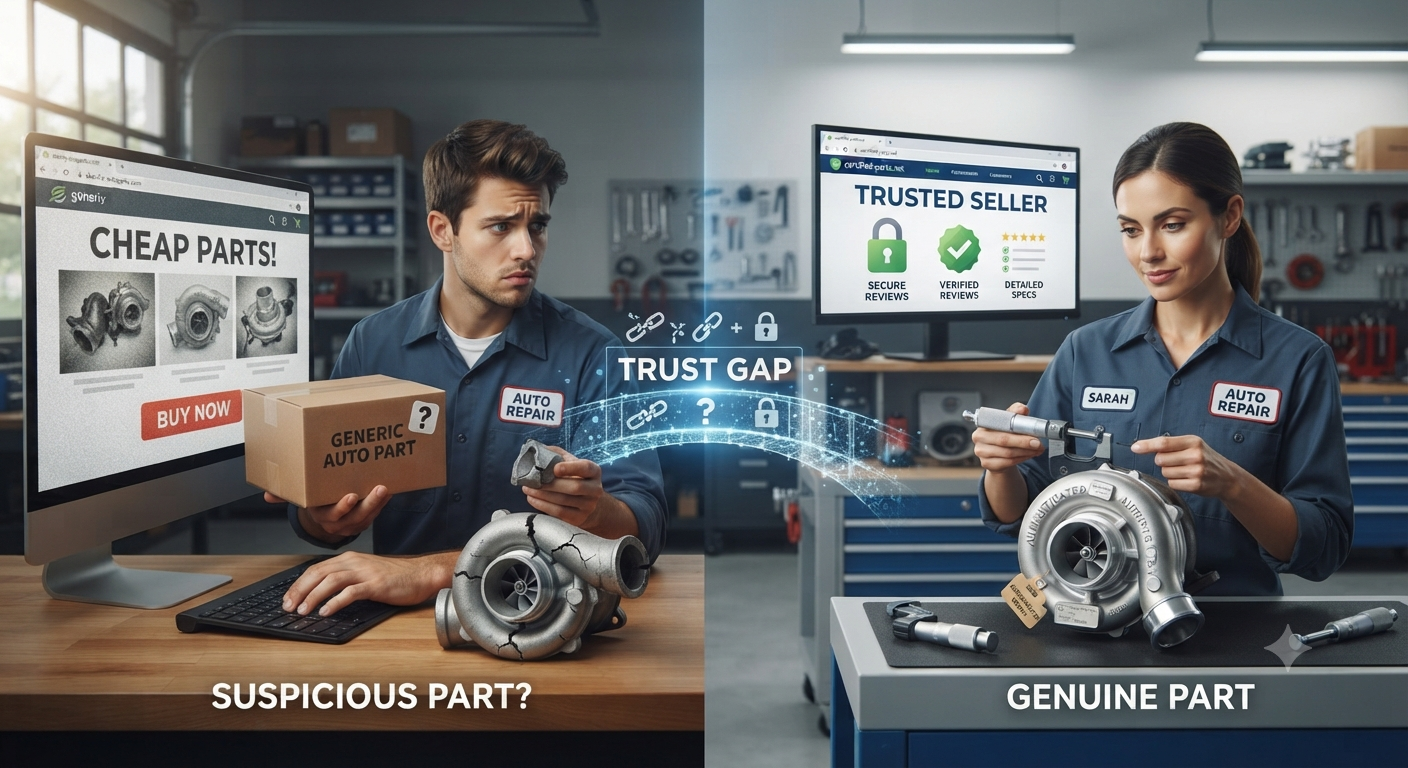
Technology changes the efficiency of transactions. It does not change the underlying value equation of the market. Part quality still matters. The condition descriptions still need to be accurate. The shipping still needs to be reliable. And when something goes wrong, the experience of getting it resolved still determines whether a buyer returns. The industry’s trust gap (covered in depth next week) is not a technology problem. It is an execution problem. Technology can surface inventory faster and match buyers to parts more accurately. But the trust that professional buyers extend to a used parts supplier is earned through consistent fulfillment, not through software. The operators who will benefit most from the technology transformation are the ones who had the operational fundamentals in place before the technology arrived: accurate inventory management, honest condition grading, reliable shipping, and responsive service when something does not go as expected. Technology amplifies what is already there. It does not substitute for it.
A Prediction the Industry Should Take Seriously
Within five years, the search for a used auto part will, for the majority of professional buyers, begin and end on a platform with real-time inventory verification and AI-powered fitment matching. The phone call to verify will become the exception rather than the standard. The manual price negotiation will give way to market-priced transactions executed online. The buyer who spends significant time sourcing a single component will be doing so by choice, not necessity. The vendors and recyclers whose inventory is accessible and accurately represented on those platforms will see their buyer reach expand dramatically, without adding geography, staff, or marketing spend. The vendors whose inventory is not accessible will experience the same technology transition, but from the buyer’s side. They will simply become progressively harder to find. Technology does not change what this market is. It changes who can be found in it.
For vendors: is your inventory accessible on the platforms professional buyers are actively using? For buyers: how much sourcing time per week could you recover with fully digitized, accurate real-time procurement?